
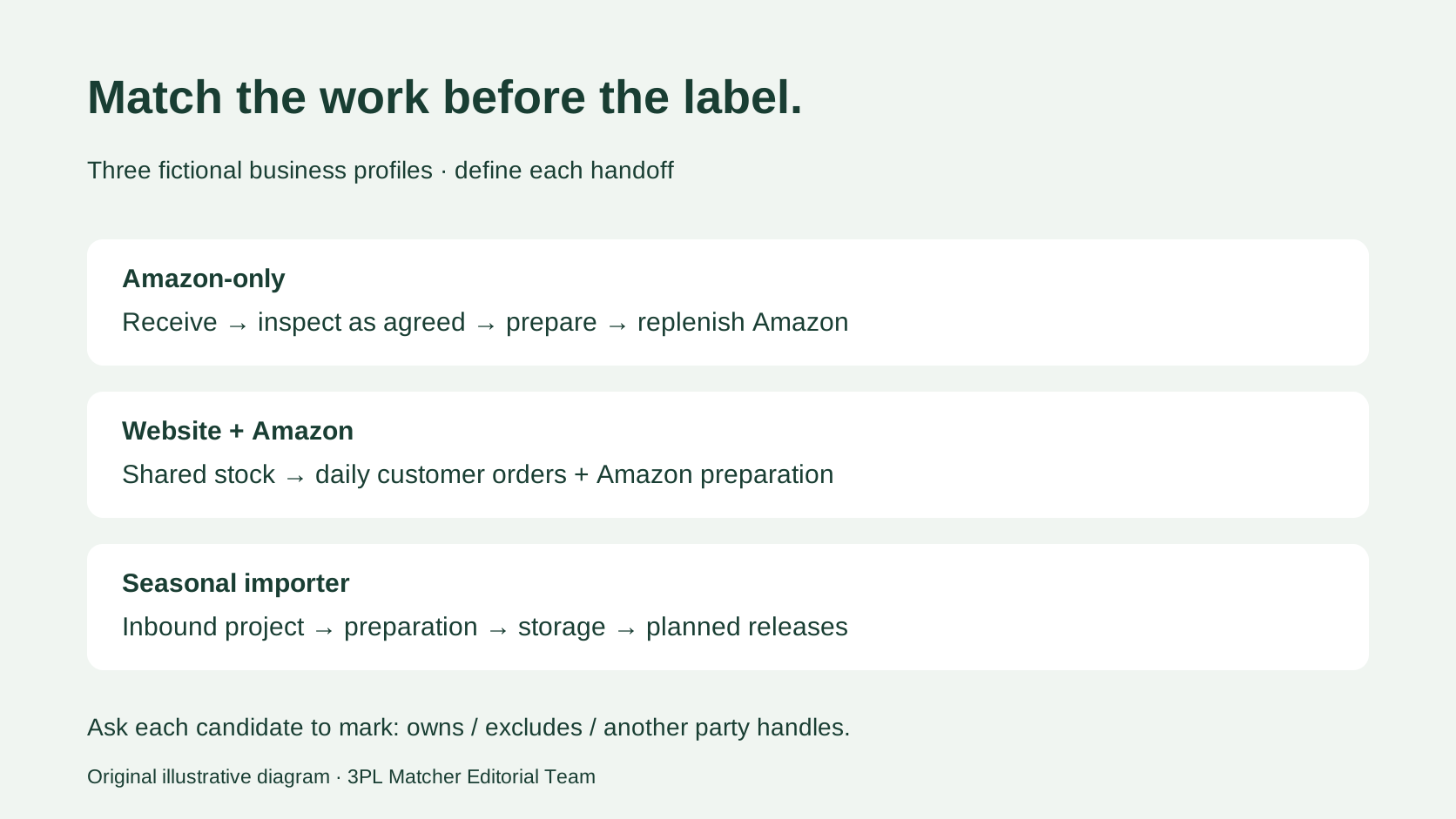
“We sell on Amazon” is not a complete warehouse brief. One brand needs imported stock inspected and prepared for replenishment. Another needs the same inventory to supply Amazon and ship daily website orders. Those are different operating assignments, even when both businesses describe the search as FBA support.
Begin with the movement of goods. Who receives them, changes their packaging, stores them, sends them to Amazon and handles orders that never go to Amazon? Provider labels are less useful than answers to those questions.
Separate preparation from customer fulfillment
Amazon’s FBA preparation guide describes packaging, labeling and preparing inventory to meet its requirements before it reaches fulfillment centers. It directs sellers to applicable requirements, which vary with the products. That defines a preparation assignment; it does not establish that a particular prep provider can also run your direct-to-consumer operation. Amazon FBA preparation guide.
For each SKU, identify the preparation tasks you actually need. Obtain a current written scope rather than assuming that “Amazon ready” includes inspection, relabeling, bundles, shipment creation or every product-specific requirement.
Three fictional businesses, three scopes
This is an original matching exercise using invented business profiles. It is not a comparison of named providers or a claim that one model performs better.
| Business profile | Work to establish | Search direction |
|---|---|---|
| Amazon-only replenishment business | Receive, inspect as specified, prepare, store briefly and dispatch replenishment | Evaluate a prep specialist against that complete scope |
| Website brand adding Amazon | Daily individual orders plus preparation and scheduled replenishment | Evaluate providers that can demonstrate both workflows |
| Seasonal importer without daily customer orders | Variable inbound volume, defined preparation projects and storage between releases | Compare project scope and capacity commitments, not a DTC feature list |
The first profile does not automatically need a broad service bundle. The second should not assume an Amazon-prep offer includes customer-order cutoffs, returns or parcel exception handling. The third needs clarity about inventory waiting between projects even when nothing is being prepared.
Test the shared-inventory question
For a mixed-channel brand, ask how stock is reserved for replenishment without accidentally removing the units needed for website orders. Request an example showing quantities before reservation, after preparation and after dispatch.
Also ask whether prepared inventory can be redirected and what rework that would require. A provider should explain the actual packaging and labeling implications for your products. Do not assume channel-ready stock is interchangeable merely because the SKU number is the same.
Quote each movement explicitly
Use separate lines for receiving, agreed inspection, preparation, storage, dispatch and any customer-order service. Request minimums and exclusions. For a project-based profile, ask how a delayed inbound shipment changes reserved labor or space charges; leave the amount unknown until quoted.
Amazon’s own storage arrangements are separate from any charges incurred while goods sit with the prep provider. Its FBA page describes storage fees based on daily average volume. Avoid treating the upstream warehouse and Amazon as one undifferentiated storage line. Amazon FBA.
Choose the narrowest complete fit
The useful target is a provider capable of all required work with understandable handoffs. Extra capabilities can support growth, but should not distract from missing tasks today. Send candidates the same flow diagram and ask each to mark what it owns, what it excludes and what another party must do. That produces a much better match than choosing between two broad service labels.
Related reading
Sources
- Amazon explains FBA preparation and product-specific requirements — accessed 2026-10-06.
- Amazon describes its own FBA storage fee basis — accessed 2026-10-06.