
A store orders three cases. A consumer orders three individual units. The number three appears in both orders, but the warehouse has very different work to do.
If your brand sells wholesale and DTC from the same inventory, make the unit of measure part of your shortlist. A provider that supports both channels still needs to show how your products move through each one.
Describe the packaging before requesting a quote
GS1 US distinguishes eaches, inner packs, cases and mixed cases. Those distinctions help describe what is packaged and traded; they do not automatically configure your store or warehouse system. GS1 US packaging levels.
Give the candidate a product hierarchy: the individual sellable unit, units per inner pack if used, units per case, identifiers and which levels customers may order. Do not assume a SKU suffix is enough to communicate the conversion.
Try one small quantity test
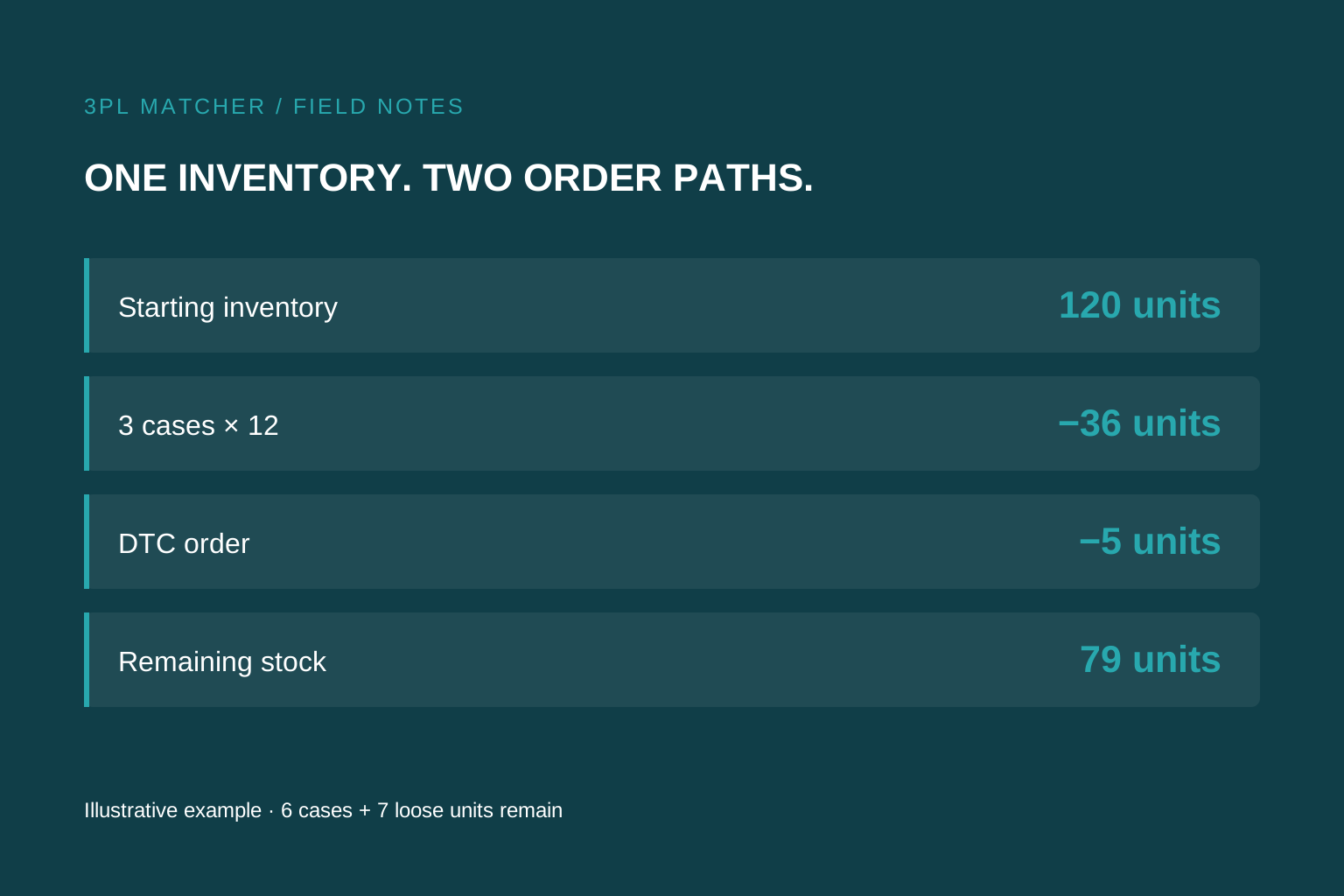
Here is a fictional product with 12 units per case. Start with ten unopened cases and no loose units: 120 units in total. A wholesale order requests three cases. A DTC order requests five individual units.
The correct combined demand is 3 × 12 + 5 = 41 units. Remaining inventory is 79 units. If the warehouse fulfills wholesale from three full cases and opens one more case for DTC, the remainder is six unopened cases plus seven loose units.
Ask the candidate to show that outcome in its proposed workflow. If a screen shows “79,” can the team also identify which stock is available as full cases? If the two order lines are mistakenly treated as three units plus five units, the system would subtract only eight and show 112. That is a hypothetical mapping error, not a finding about any provider.
Decide whether case breaking is allowed
Some operating plans allow an unopened case to supply individual orders. Others reserve cases for wholesale commitments. State your rule and ask who can authorize a change. A case-opening decision can affect later orders even when the total unit count is correct.
Request separate instructions for full-case picks, loose-unit picks and replenishing the DTC pick location. Confirm how identifiers and conversions are maintained when a supplier changes pack size. Do not let a new case quantity inherit an old conversion without review.
Ask for pricing that matches the path
Have the provider quote the same two orders. Identify any full-case handling, each picking, replenishment, packing and shipping charges separately. An individual-unit pick price is not necessarily a case-handling price, and a case shipped intact may have a different packing requirement.
No rate is assumed in this article. Request an actual quote using your packaging and volume. For delivery costs, include the destination and shipping service rather than assuming wholesale always travels by freight or DTC always uses the cheapest parcel option.
Use the demonstration to narrow the shortlist
Record whether the candidate can explain the conversions, preserve the stock format and produce usable pick instructions. If an answer depends on a future integration change, mark it as unproven and ask what acceptance test will close the gap.
We have not run this test against a WMS; it is a repeatable scenario for your selection process. Pair it with the retail-ready 3PL guide and DTC and retail matching guide when defining the rest of your channel requirements.
Sources
- Source 1 — accessed September 25, 2026.