
Delivered to whom?
An event shipment can reach the correct building while the booth team still cannot find it. A receiving dock, venue storage room and exhibition stand are different custody points. Define the final handoff before asking a fulfillment provider whether it handles events.
Historical meeting-shipping guidance from MPI, hosted by FedEx, highlights the distinction between tracking material to a property and tracking it within the property. Treat that as planning context, not current venue instructions or a promise of available services. Meeting-shipping guide.
Obtain the actual organizer or venue instructions for your event. Confirm the receiving window, labeling requirements, authorized recipient and arrangements for moving freight to the stand. Those details can change between events at the same address.
Match the provider to the asset journey
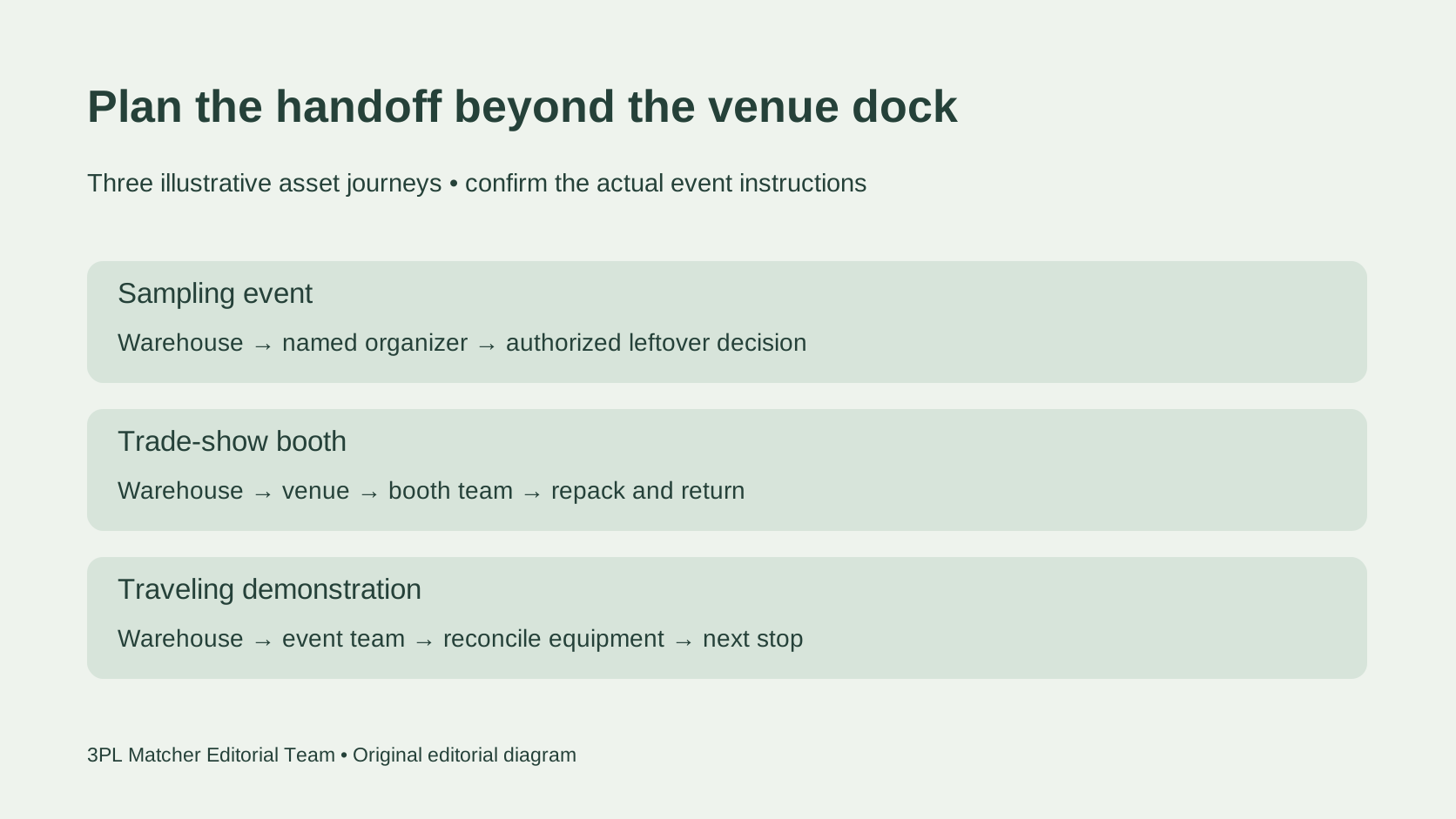
Compare three illustrative briefs. A one-day sampling event needs consumable cartons delivered to a named organizer; there may be no reusable assets to recover. A trade-show booth needs displays, tools and samples coordinated with a setup deadline, followed by a return journey. A traveling demonstration program needs serialized equipment checked back in and made ready for the next stop.
These are constructed profiles, not observed customer cases. They show why “event shipping” is too broad a capability label. A provider suited to consumable cartons may not support equipment inspection or reverse movement on a tight schedule.
Use three gates in the provider conversation
First, map custody. Who accepts the shipment at each point, and what evidence confirms the handoff? Ask who resolves a delivery that was signed for at the property but cannot be located by your staff.
Second, map timing. Separate the venue's receiving window from the booth-ready deadline. Ask which activities the 3PL actually controls and which depend on the carrier, organizer or another contractor. Avoid accepting a broad service promise that blends all four parties.
Third, map the return. Name the person who repacks, supplies labels and tenders the shipment after the event. Agree how the warehouse records missing components, damage and readiness for reuse. A returned box is not necessarily a complete kit.
Build a reusable asset manifest
For reusable equipment, list the identifier, expected quantity, accessories and condition information you need captured. Have the provider quote the work needed to reconcile that manifest. Do not assume a standard receiving fee includes inspection, charging, cleaning or repacking.
For consumable stock, decide whether leftovers return, move to another event or require another authorized disposition. Keep that instruction explicit so surplus is not quietly treated as waste.
Choose on the difficult handoff
Send each candidate the same event brief and ask for a responsibility map. Record exclusions as carefully as capabilities. If the warehouse manages dispatch and return but not venue movement, identify who covers that gap before selecting it.
The strongest match is the provider whose documented scope fits the journey your assets must complete. Parcel delivery is one part of that journey; event readiness and recovery deserve their own acceptance checks.
Related reading
Sources
- Primary source or planning context — accessed 2026-10-15. Historical MPI meeting-shipping guidance hosted by FedEx distinguishes movement to a property from tracking within it; not a current venue contract, rate sheet or service guarantee.