
A spare-parts catalog can look like ordinary small-item ecommerce until one missing component stops a customer’s equipment. The commercial importance of that order may have little connection to its price or the brand’s average daily volume.
Begin the provider brief with the work the part supports. Include routine replenishment, urgent breakdown requests and items that need compatibility confirmation. A low monthly order count does not describe the service model on its own.
Separate three order paths
This original framework uses fictional business requirements, not named provider performance.
| Order profile | Capability to establish | Decision owner |
|---|---|---|
| Routine replenishment | Normal picking, packing and scheduled dispatch | Standard order workflow |
| Urgent equipment-down request | Authorized priority release and a feasible transport handoff | Named urgent-service contact |
| Uncertain part revision | Hold and compatibility confirmation before release | Brand technical owner |
The third path protects the first two. A warehouse should not substitute a visually similar part unless the brand has supplied an approved rule. Record the relevant part and revision identifiers in the order instructions.
Carrier availability is only one link
FedEx describes U.S. SameDay delivery within hours depending on flight availability. That is an example of an urgent transport service, not proof that a warehouse can retrieve your part or meet a specific request. FedEx SameDay.
For your actual origins, destinations and goods, verify the available service and required handoff. Keep the warehouse’s ability to pick and release separate from the carrier’s ability to transport. Neither alone establishes the full customer promise.
Work backward from a real deadline
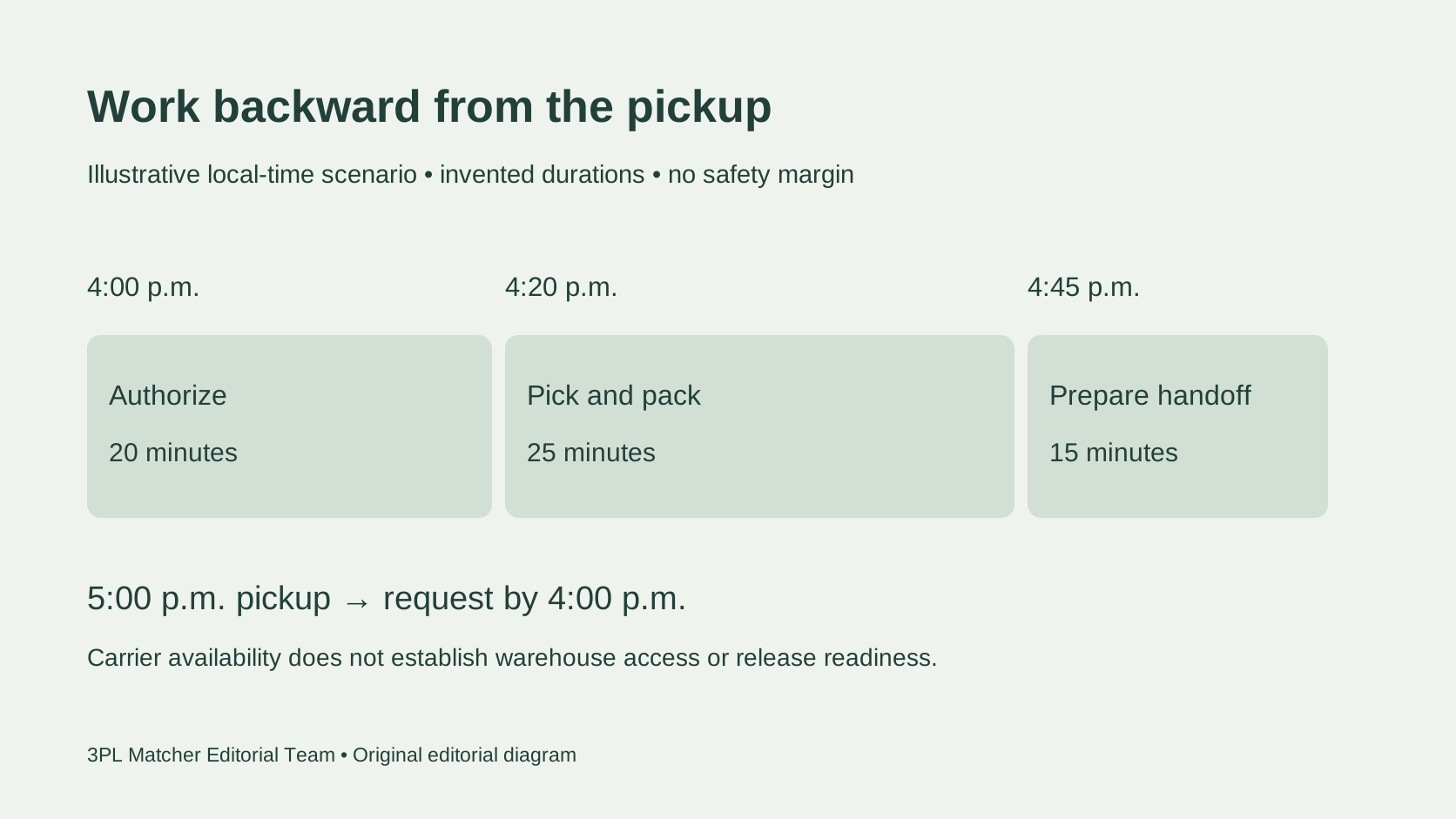
Illustrative timing exercise: assume a confirmed carrier pickup is at 5:00 p.m. in the warehouse’s local time. The proposed process needs 20 minutes for authorization, 25 for picking and packing, and 15 for handoff preparation. With these invented durations, the request must enter by 4:00 p.m. if the steps run sequentially and nothing interrupts them.
A request received at 4:30 p.m. does not fit merely because the warehouse advertises a 5:00 p.m. pickup. The calculation includes no safety margin and is not a recommended service promise. Ask the provider for evidence supporting its actual timing and contingency plan.
Check access when ordinary operations stop
If after-hours service matters, ask who receives the request, who can enter the facility and who may authorize extra cost. Confirm whether access applies to the specific stock location. A staffed phone line is not evidence that someone can retrieve the item.
Price the standby commitment and actual callout work separately where applicable. Leave fees unknown until quoted; do not assume urgent handling is included in ordinary pick pricing.
Keep the matching decision narrow
The right candidate should explain how it identifies the part, clears uncertainty, releases the order and confirms the handoff. Ask for a controlled walkthrough of one routine and one urgent case before transferring inventory.
A useful shortlist fits the small number of orders that need exceptional handling as well as the predictable daily work. That is more informative than choosing on parcel volume alone.
Related reading
Sources
- FedEx describes SameDay service with availability conditions — accessed 2026-10-09.