
A product launch creates two different warehouse assignments. First comes a concentrated group of orders that should leave under a coordinated plan. Then come late orders, corrections, replacements and remaining stock. A provider that is attractive for the first wave may have terms or workflows that fit the tail poorly.
Describe both phases before requesting quotes. Give candidates a realistic order file, expected inventory arrival, required packout and the date after which the business expects ordinary daily service.
Define the release gate
Write down what must be true before orders enter fulfillment: required inventory is received, the approved packout is available, address exceptions are handled and the order file is accepted. The warehouse should be able to identify the orders that pass the gate and those that do not.
For U.S. merchandise orders within its scope, the FTC rule requires a reasonable basis for the advertised shipping timeframe and addresses consent to delay or refund when the promised timeframe cannot be met. Treat that as a reason to connect customer promises to a credible release plan, not a reason to invent certainty. FTC merchandise-order rule. Specific business and order circumstances need their own compliance review.
Model the work that can actually start
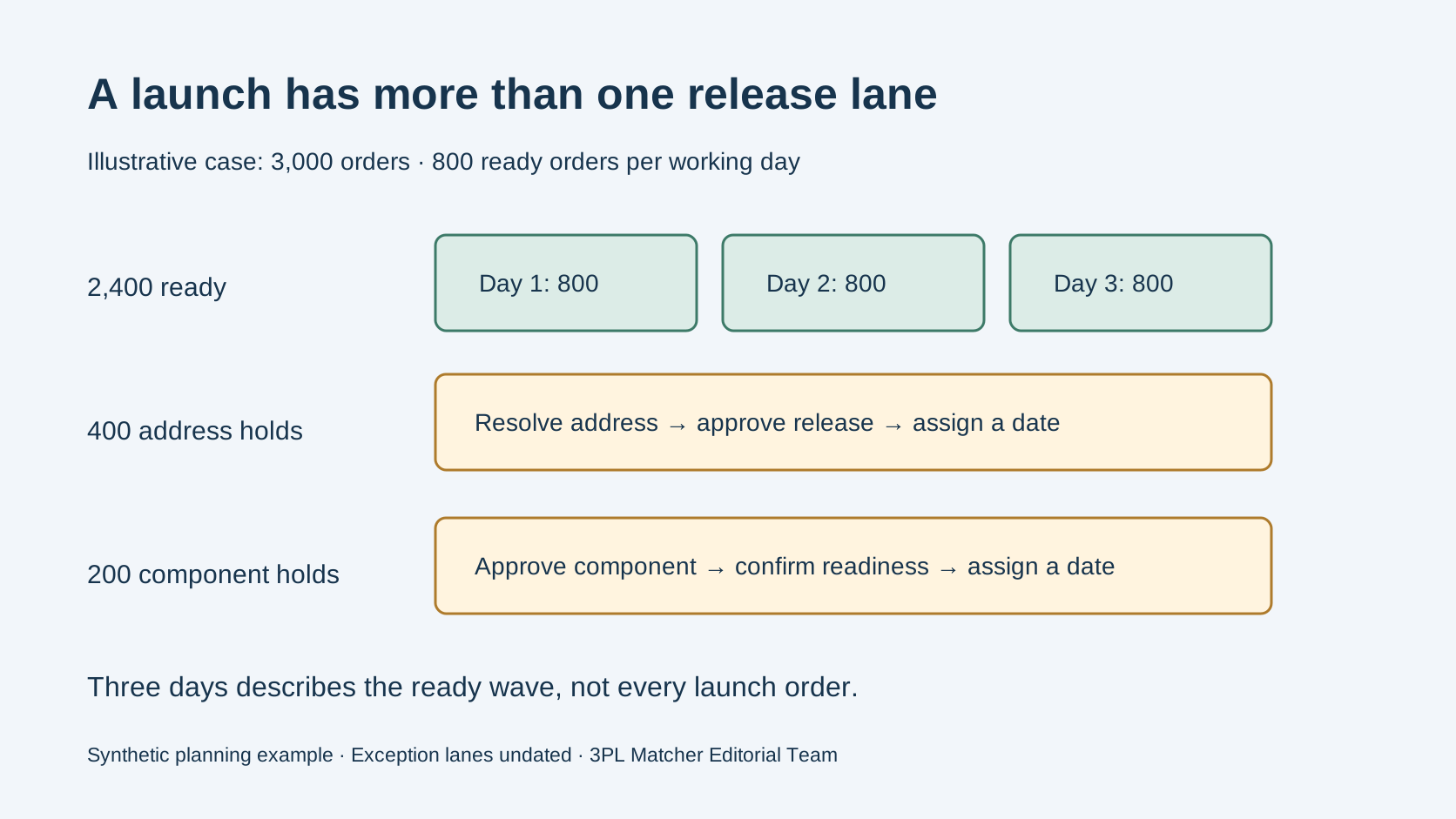
Illustrative planning case: a launch has 3,000 orders. Assume 2,400 are ready on release day, 400 need an address decision and 200 lack an approved component. The provider’s hypothetical usable capacity is 800 orders per working day for this exact order mix.
The ready group requires three working days at that capacity. Dividing all 3,000 by 800 and rounding to four days does not establish the completion date for every order: the unresolved 600 cannot start until their blockers clear. This exercise assumes no new arrivals, interruptions or capacity competition.
Ask each candidate to show its plan for those separate groups. A useful response assigns the unresolved orders an owner and an update point rather than blending them into a single completion estimate.
Compare the launch and the tail
| Phase | Capability to establish | Commercial question |
|---|---|---|
| Initial release | Agreed work rate for the approved order mix | Which commitment secures that capacity? |
| Exceptions | Holds and controlled re-release | What extra work is charged? |
| Ongoing tail | Small daily order flow and remaining stock | What minimums or storage terms continue? |
This is an original matching framework, not a survey of provider capabilities. Ask candidates to mark exclusions rather than assume that launch support includes every later task.
Set an honest customer-update handoff
Agree when the warehouse reports ready, held, dispatched and remaining quantities. The brand should decide the customer message from those facts. Do not describe an uploaded order file as a shipment or use one completed wave to imply the whole launch has left.
Plan who approves release changes if packaging, stock or customer information changes late. The provider needs a versioned instruction, and support needs to know which orders it affects.
The best match is the provider that can explain both the initial workload and what remains afterward. Use the launch exercise to expose missing responsibilities before paying to move inventory.
Related reading
Sources
- FTC explains shipping-promise and delay requirements for covered merchandise orders — accessed 2026-10-08.