
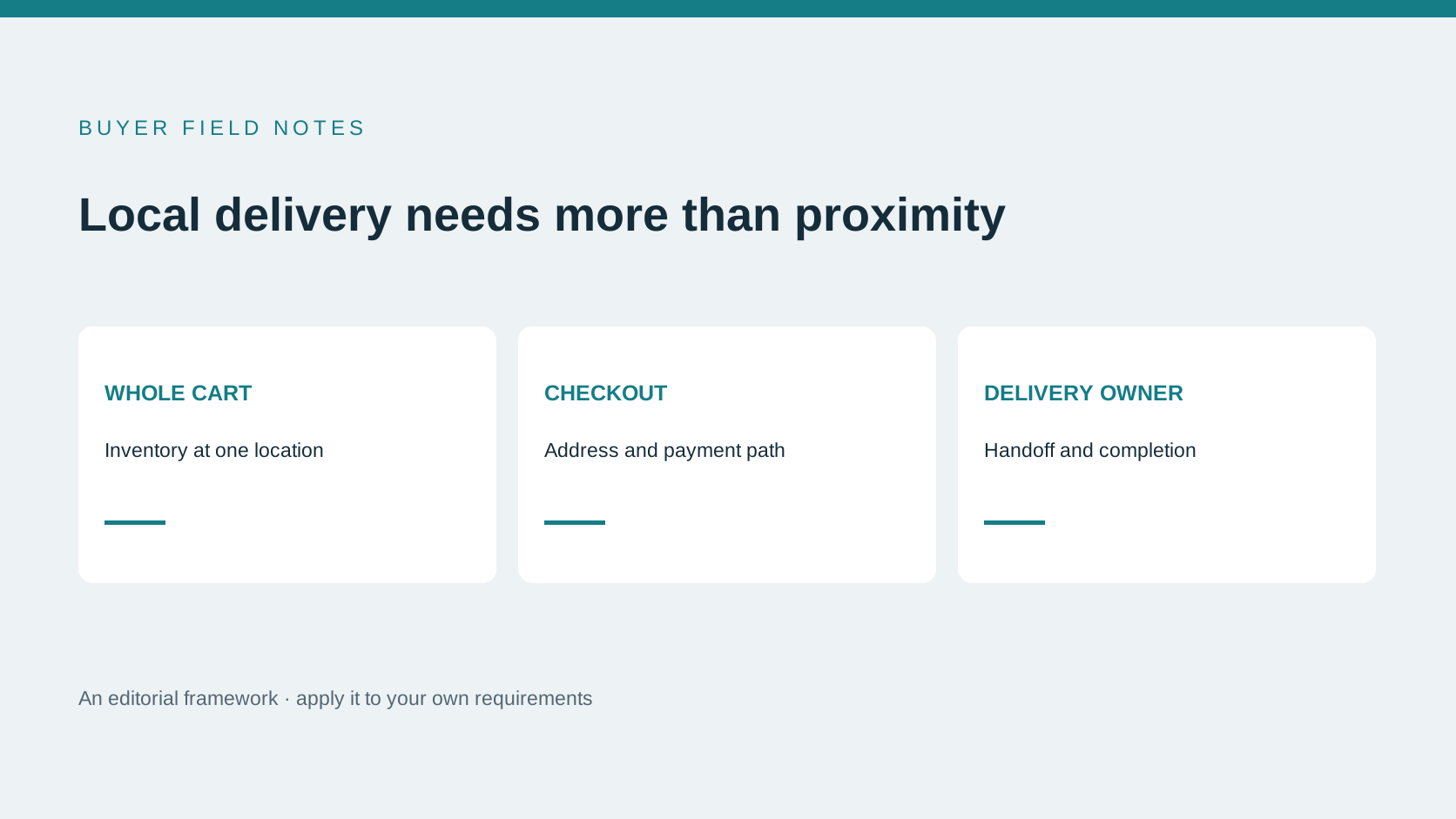
A warehouse twenty miles from your customers may look like an obvious local-delivery partner. But geography only answers where the building is. It does not establish that a customer can choose local delivery, that the location holds the whole order, or that someone owns the final handoff.
Shopify's native local-delivery documentation requires the order's physical products and available inventory to support fulfillment from one location. It also describes address and checkout eligibility and warns that third-party shipping apps can conflict with the feature. These are platform requirements, not proof that any particular 3PL supports the workflow. Shopify local-delivery guidance.
Use four deliberately different carts
We designed a small acceptance matrix for a proposed Shopify setup. These are test cases to run with a candidate provider, not completed tests or measured success rates.
| Proposed case | What it isolates | Evidence to request |
|---|---|---|
| In-zone address, whole cart available locally, supported checkout | Basic eligible journey | Delivery option and resulting fulfillment task |
| Same address, one item unavailable locally | Whole-cart dependency | Observed checkout outcome and fallback explanation |
| Whole cart available, address outside configured zone | Geographic boundary | Observed shipping alternatives |
| Same eligible cart with another accelerated checkout | Payment-path dependency | Observed option availability for that method |
For each test, save the cart contents, location quantities, address category and checkout method. Without those inputs, two demonstrations that appear inconsistent may simply be exercising different rules.
Shopify currently says native local delivery works with Shop Pay but not the other accelerated checkout methods listed in its documentation. Verify the actual checkout path; do not generalize a successful Shop Pay test to every payment route. Eligibility details.
Follow the order beyond checkout
A visible option is only the beginning. Ask how the order becomes a warehouse task, who prepares it, how the driver receives it and who records completion. Request a proposed response to an undeliverable stop and a customer asking to change the address.
Confirm which organization supplies the delivery service. The warehouse, the brand and a separate delivery company may each perform a different step. Make the handoff owner explicit before interpreting a proposal as an end-to-end service.
Request a quote that separates preparation from delivery. Ask about minimums, waiting, failed attempts and returns, but leave the figures unknown until the provider supplies terms. Proximity does not establish price or capacity.
Match the workflow before expanding the zone
Treat the four cases as a gate for a small pilot. If a cart fails because one item is elsewhere, the remedy may concern inventory placement rather than route distance. If a payment path removes the option, the remedy concerns checkout design rather than warehouse speed.
Do not disable customer payment options automatically to make a demonstration pass. Evaluate that commercial tradeoff with the brand and verify whether a different supported workflow is appropriate.
A useful shortlist contains providers that can explain the whole journey with your configuration. The closest building is a candidate, not a conclusion.
Related reading
Sources
Accessed September 30, 2026. Recheck time-sensitive terms before publication.
- https://help.shopify.com/en/manual/fulfillment/setup/delivery-methods/local-delivery