
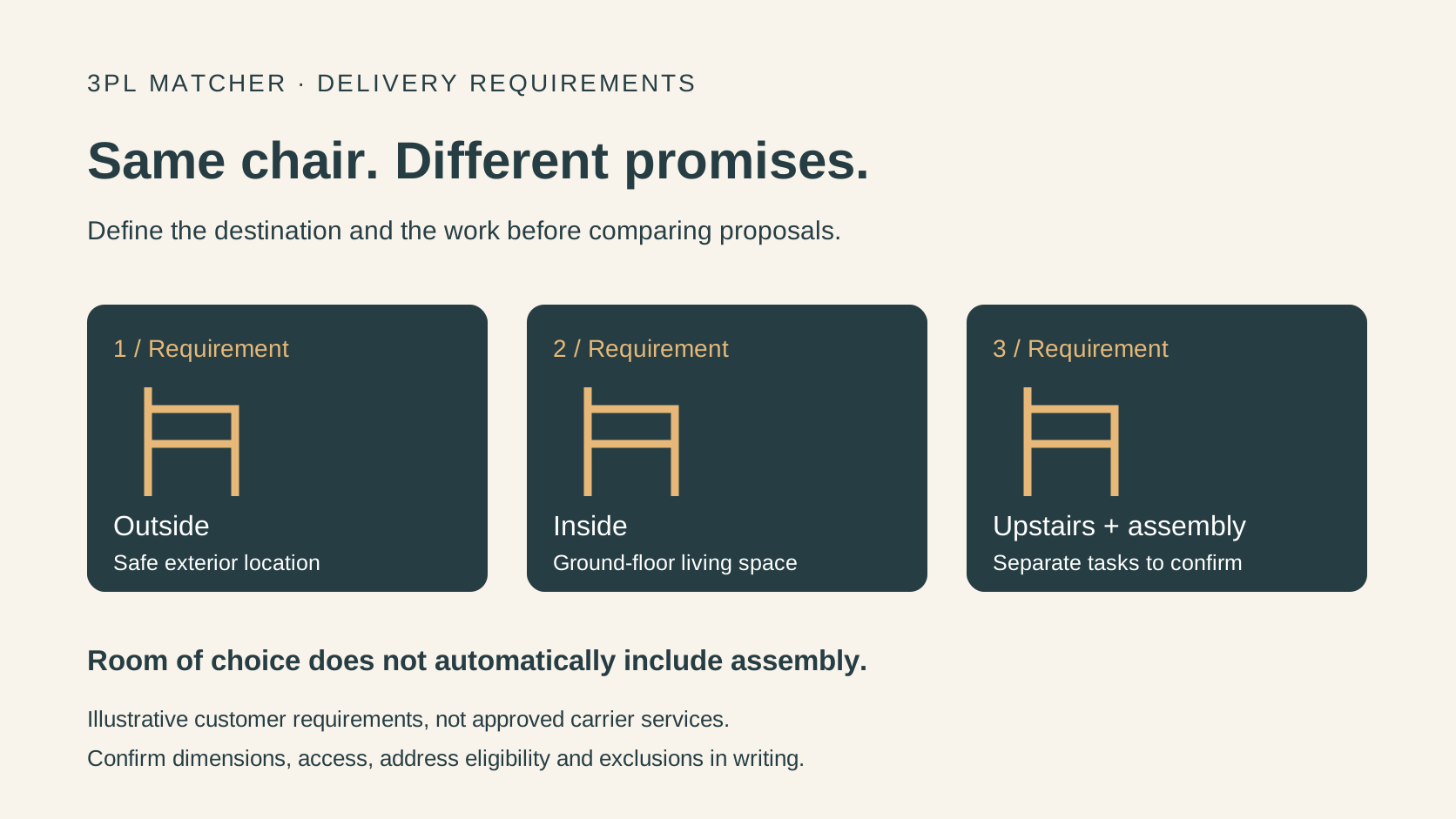
Two furniture brands can ship the same boxed chair and need different fulfillment partners. One promises delivery outside the home. The other promises placement in an upstairs room. The carton may be identical, but the service the customer bought is not.
Start the shortlist with that promise. A warehouse that stores and dispatches furniture still needs a delivery arrangement matching the destination, access conditions and work expected at the door.
Replace broad service labels with actions
Terms such as white glove can mean different things in different proposals. Specify the tasks: appointment, signature, crossing the threshold, climbing stairs, placement, packaging removal, assembly and removal of old furniture. Ask each candidate to mark each task included, excluded or subject to confirmation.
Published carrier terms show why this matters. FedEx Freight Direct's U.S. agreement distinguishes Basic outside delivery from Standard delivery to the first available living space and Premium room-of-choice service, subject to restrictions. Its page separately excludes installation and haul-away, and requires prior written approval for assembled or pre-built furniture. These are that carrier's documented terms, not definitions that bind every provider. FedEx Freight Direct
Compare three promises for one product
Our original scoping exercise uses one hypothetical boxed chair and three customer requirements. We have not checked a real parcel, address or carrier booking; no row below establishes shipment eligibility.
| Customer expectation | Required evidence from the 3PL proposal | Gap to resolve |
|---|---|---|
| Leave at a safe ground-level exterior location | Appropriate delivery scope and destination coverage | What happens if the location is inaccessible? |
| Carry into a ground-floor living space | Inside-delivery service and access conditions | Does the quoted service stop at the threshold? |
| Place upstairs and assemble | Explicit stairs and assembly scope | Are separate providers or arrangements required? |
The third promise cannot be fulfilled merely by buying a service described as room of choice if assembly is excluded. Treat each task as a requirement instead of letting an attractive service name fill the blanks.
Bring dimensions and access into the quote
Supply packed dimensions, weight per piece, number of pieces and whether the product arrives assembled. Include the destination mix and known access constraints. Ask how coverage and eligibility will be checked before the order is accepted, not after it has shipped.
Keep warehouse work separate from delivery work. A 3PL may assemble or inspect an item before dispatch; that does not mean the delivery crew assembles it in the home. Record where each task happens and who owns damage or missing-component exceptions at the handoff.
Compare the full customer promise
Request the charges for the actual service, including applicable appointments, access exceptions or repeat attempts. Do not insert guessed surcharges when a term is unknown. Get the scope clarified and leave that line unresolved until you have an answer.
Make your checkout and support wording reflect the purchased service. If assembly is not offered, a customer should learn that before buying. If coverage varies by address, establish how the order is held or offered an alternative before making a promise the provider cannot meet.
This exercise does not choose a carrier or a winning 3PL. It helps separate a warehouse shortlist from a delivery-service shortlist and then join them. The right match is the combination that can perform the work your customer expects, with the exclusions visible before the sale.
Related reading
Sources
- Documented U.S. delivery service distinctions and exclusions — accessed 2026-10-05.