
A warehouse that fulfills cosmetics may still be the wrong fit for a fragrance launch. The important distinction is the actual product and shipment: its formulation, package, destination and service. “Beauty fulfillment” is a category label, not an acceptance decision.
Build the shortlist from a product-and-service matrix. Keep unknown classifications unresolved until the responsible parties supply the missing information. Do not let a familiar brand name or a small bottle size stand in for that work.
Begin with an explicit carrier constraint
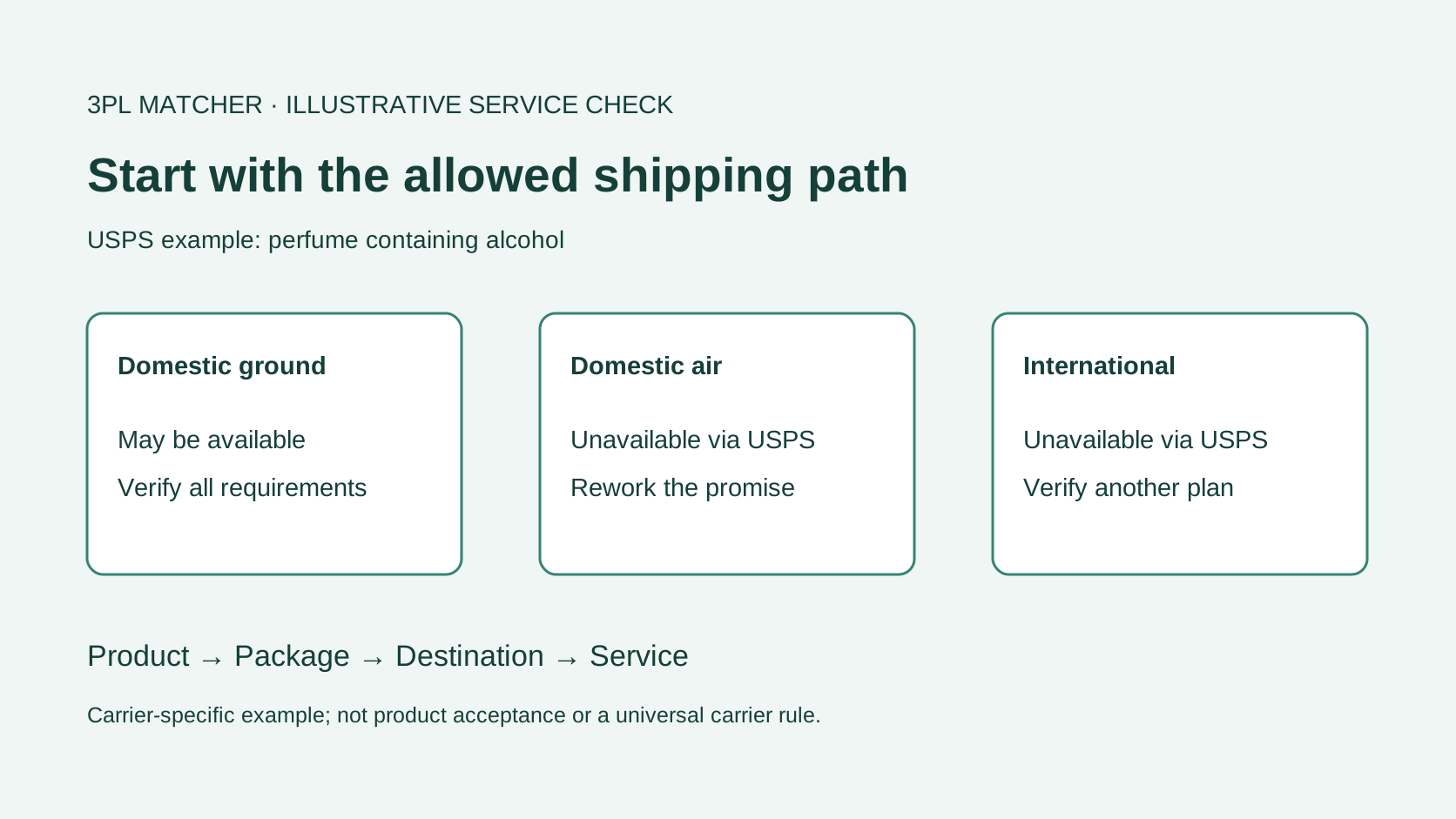
USPS states that perfume containing alcohol cannot be sent internationally or through domestic air transportation, while domestic ground transportation may be available. That does not waive applicable mailability, quantity, packaging or marking requirements. USPS shipping restrictions.
This is a USPS-specific example. Do not turn it into a claim that all carriers use identical rules or that every ground shipment is acceptable. Obtain product-specific acceptance and instructions for the actual service your 3PL proposes.
Separate three order groups
Our original matching exercise uses three fictional order groups chosen to expose conflicts between a marketing promise and a service restriction. It is not a carrier comparison or product classification.
| Illustrative order group | Matching issue | Evidence to request from the 3PL |
|---|---|---|
| Alcohol-containing perfume to a domestic destination | Need an eligible transport path | Confirmed product acceptance, service and packout requirements |
| Same product sold with an air-service promise | The promise may conflict with the proposed USPS route | An approved alternative service or revised customer offer |
| Same product ordered internationally | USPS example is unavailable | A separately verified carrier and destination plan, or a sales restriction |
A provider that cannot serve one group may still fit a deliberately narrower business. The poor match is an arrangement that silently routes unsupported orders into an exception queue after the customer has paid.
Evaluate mixed baskets before selecting the warehouse
A shopper may buy perfume with lotion, accessories or a gift set. Ask how the provider identifies the restricted item and prevents an inappropriate service from being selected for the combined order. If it proposes separate parcels, obtain the handling, customer-message and cost implications.
Do not assume that a second warehouse solves this problem. It may add stock duplication without changing service eligibility. Geography matters after the allowed shipment paths are established.
Ask for a demonstrated decision path
Give each shortlisted provider the same product information and three proposed orders. Request its written acceptance conditions, responsible reviewer, exception behavior and the information it still needs. Safety Data Sheets and other product documentation may be relevant, but the responsible specialists should determine what is required.
No provider test or product classification was performed for this article. Before launch, have the approved workflow checked using representative orders, including an unsupported destination. Keep the customer offer consistent with that result. A useful match tells you both what the 3PL can ship and how it prevents an order it cannot support from becoming an unkept promise.
Related reading
Sources
- USPS perfume and hazardous-material shipping restrictions — accessed 2026-10-17.