
A fulfillment-model decision gets easier when you stop asking one provider to represent every order in the business. Standard single-item shipments, branded gift kits and products needing special handling may need different operating arrangements.
Before comparing Amazon Multi-Channel Fulfillment, or MCF, with an independent 3PL, divide the order file by non-negotiable requirements. Then ask which requirements are documented, which need configuration and which remain unknown.
Begin with packaging and handling
Amazon's official MCF FAQ describes unbranded packaging as the default, while noting exceptions where it may lengthen delivery times. It also describes a blank-box selection and says that unbranded packaging does not support items longer than 56 inches or heavier than 49.9 pounds. Those are limits of that packaging feature, not a statement of every MCF service limit.
The FAQ also explains that carrier-blocking and packaging settings may require configuration in an integration. Read the requirements of the sales channel as well. A provider's available setting does not itself establish that your orders comply with a marketplace's current policy.
Plain packaging is not the same requirement as a custom printed box, a handwritten message or an assembled promotional kit. Ask separately about each task. Do the same with an independent 3PL; the label “full service” is not proof that your specific workflow is included.
Create three initial order groups
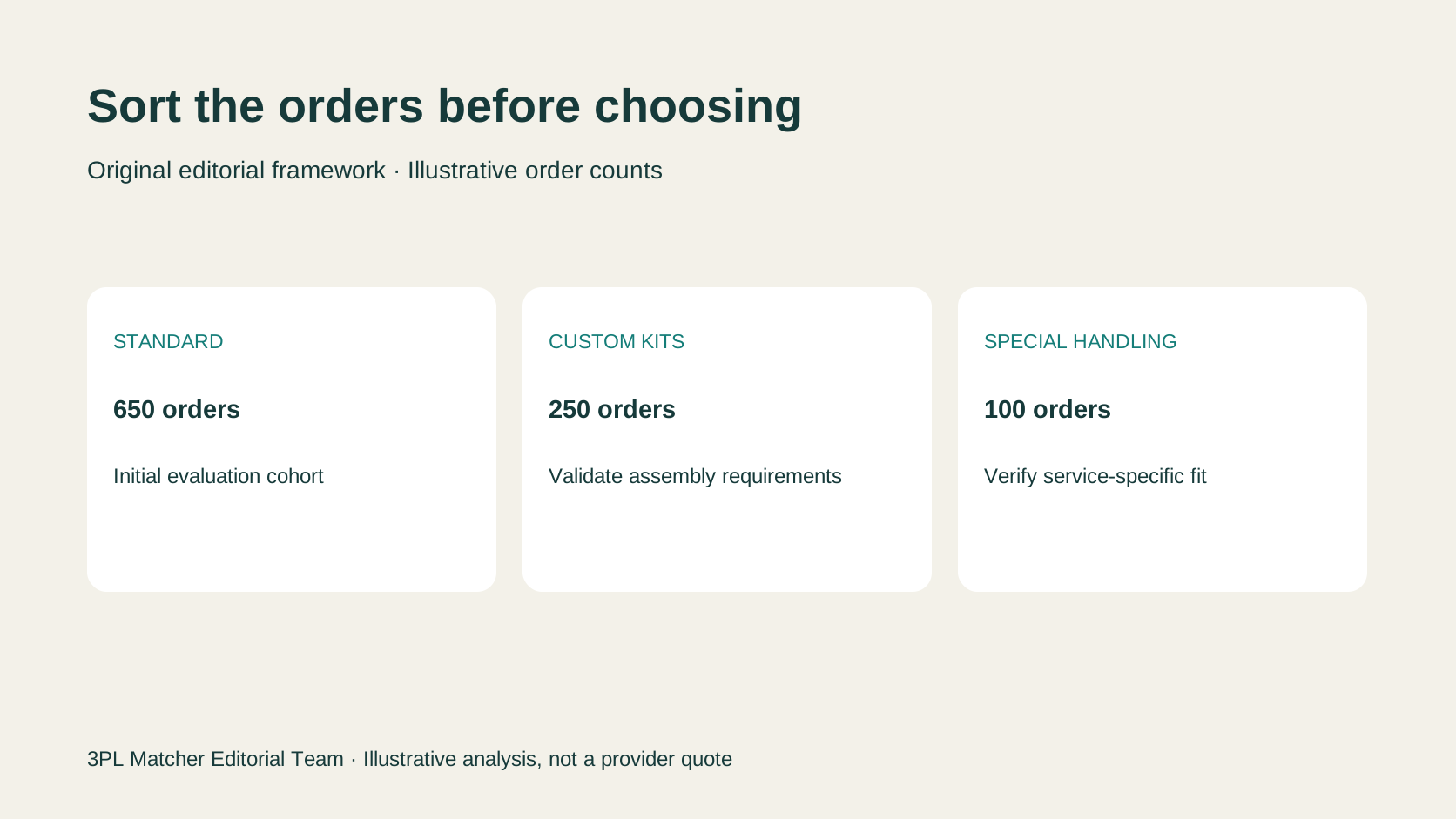
We built a hypothetical 1,000-order file to show the screening process. The groups are deliberately non-overlapping, and the quantities are invented for illustration.
| Order group | Orders | First verification question |
|---|---|---|
| Standard products, plain packaging acceptable | 650 | Are the products, dimensions, destination and channel eligible? |
| Custom branded kits | 250 | Can the required assembly and presentation be delivered as specified? |
| Special-handling products | 100 | Are the exact handling conditions supported and documented? |
The 650 standard orders are a starting cohort for evaluation, not a claim that MCF accepts 65% of this brand's business. Product eligibility, inventory availability, delivery needs and channel rules still need checking. The other 350 orders remain unverified; the table does not establish that they are prohibited or that an independent 3PL can handle them.
This approach prevents a low quote for the easiest group from being mistaken for a complete operating plan.
Compare the same work after checking fit
Once a group passes the capability review, price its actual items, units per order and service requirements. Include receiving, storage, preparation, returns and any required integration costs. Obtain current written terms rather than borrowing a competing provider's description of another service's fees.
Ask how rates apply when items ship separately, how returns re-enter inventory and what happens when an order cannot use the intended fulfillment route. Keep unknown charges visible until a quote resolves them.
We have not calculated a cost winner here. Without a real order file, account terms and verified eligibility, a single total would create precision without evidence.
Consider the cost of using both
A mixed arrangement can assign different jobs to different providers. It also creates decisions about inventory allocation, replenishment, order routing and support ownership. Ask who detects a failed handoff and who can reroute an order without creating a duplicate shipment.
Request a small, approved demonstration covering a standard order, a routing exception and a return before committing to a wider rollout. Those are proposed acceptance steps, not tests we have conducted.
The right match might be one provider or a combination. Let the verified order requirements decide the shortlist, then compare the total cost of keeping that arrangement working.
Related reading
Sources
Research checked October 2, 2026. Recheck source-specific requirements before publication.